 Staderlabs
 reflects pooled HBAR rewards in the HBARX exchange rate
Updated onStaderlabs develops HBARX, a Hedera liquid staking token whose exchange rate reflects the HBAR held in its staking pool. When staking rewards enter the pool, each token can represent more HBAR without a larger HBARX balance. The calculation divides pooled HBAR by circulating HBARX, so token quantity and underlying value answer different questions. Deposits create tokens at the applicable rate; redemption converts tokens back to HBAR under unstaking conditions. Understanding the difference helps explain an unchanged wallet balance, the effect of new deposits and the point when rewards stop accruing. A market sale introduces a separate trading price.
Bottom line: Staking rewards stop accruing on the HBARX included in an unstake request when the unstaking process begins.
HBAR deposits and liquid tokens serve different purposes
HBARX combines a share of pooled HBAR with a transferable token, allowing staking exposure to move into compatible decentralized finance applications.
Minting a share of the pool
A staking deposit contributes HBAR to the smart contract and creates HBARX using the exchange rate applicable to that deposit. The contract relates the new token quantity to the HBAR contributed, maintaining proportional ownership across the pool. HBARX is a Hedera Token Service (HTS) token; ETHx covers Stader’s separate ETH staking product on Ethereum.
Using HBARX in other applications
Compatible decentralized exchanges, lending applications and liquidity products can use HBARX as an asset. The staking pool accounts for the HBAR underlying the token, while an external application applies its own terms to the position it accepts. Additional application rewards and staking rewards come from different mechanisms. A quoted return from a liquidity product therefore needs its own interpretation alongside HBARX pool growth.
How does the HBARX exchange rate increase?
The exchange rate increases when rewards add HBAR to the staking pool without a matching increase in circulating HBARX. The HBARX exchange rate equals total HBAR in the staking pool divided by circulating HBARX.
Its units are HBAR per HBARX. Multiplying by a token quantity gives an amount denominated in HBAR. For a quote expressed as HBARX per HBAR, divide the HBARX quantity by that quote to calculate HBAR.
Reward additions increase the numerator. Existing holders share that additional HBAR through the conversion rate, without receiving newly minted HBARX for those rewards.
New staking deposits affect both sides of the ratio. They contribute HBAR and create corresponding HBARX at the prevailing rate. Incoming principal therefore does not constitute a reward distribution to earlier holders. Growth in the pool’s total HBAR alone cannot distinguish deposits from staking income.
A comparison between two exchange rates measures the change in HBAR backing per token over that interval. Dividing the later rate by the earlier rate and subtracting one expresses that relative change. Both rates must be expressed as HBAR per HBARX.
A token balance and its HBAR value measure different things
For a fixed HBARX holding, multiplying the token quantity by the pool exchange rate gives the HBAR value of its pool share.
Reading an unchanged wallet quantity
A wallet can display an unchanged HBARX quantity while the pool accounts for additional rewards. The conversion rate carries the change in underlying value. That observation concerns tokens still participating in the staking pool. Tokens already included in an unstaking request follow the request’s reward and release conditions, so the current pool rate alone does not describe every pending withdrawal.
Separating contributed HBAR from growth
The HBAR value of a holding includes principal as well as accumulated staking value. A reward calculation needs a matching starting position and must account for additions or removals. Comparing a changing token balance against a single earlier deposit can confuse transferred or newly purchased tokens with staking income. Pool value also differs from the HBAR a trade delivers after its price and transaction costs.
Reward fees and Hedera charges affect different amounts
Reward commissions reduce staking income, while network charges pay for transactions and use HBAR independently of the token quantity a wallet holds.
The reward deduction
Stader charges its HBARX protocol fee on staking rewards. The fee basis is the reward amount, so applying a reward commission to the entire deposited HBAR balance would calculate a different charge. Gross network rewards and the amount ultimately accruing to token holders therefore describe different quantities. A calculation using rewards already credited to holders must not subtract the same commission again.
Transaction charges in HBAR
Hedera network fees vary with the transaction. Stader does not add a staking transaction fee or charge deposit and custody fees for staking through its application. These fee categories remain separate from the reward commission. An HBARX balance also does not replace the HBAR needed to pay applicable network charges, even though both balances relate to the same network.
HBARX identifiers and quantity precision
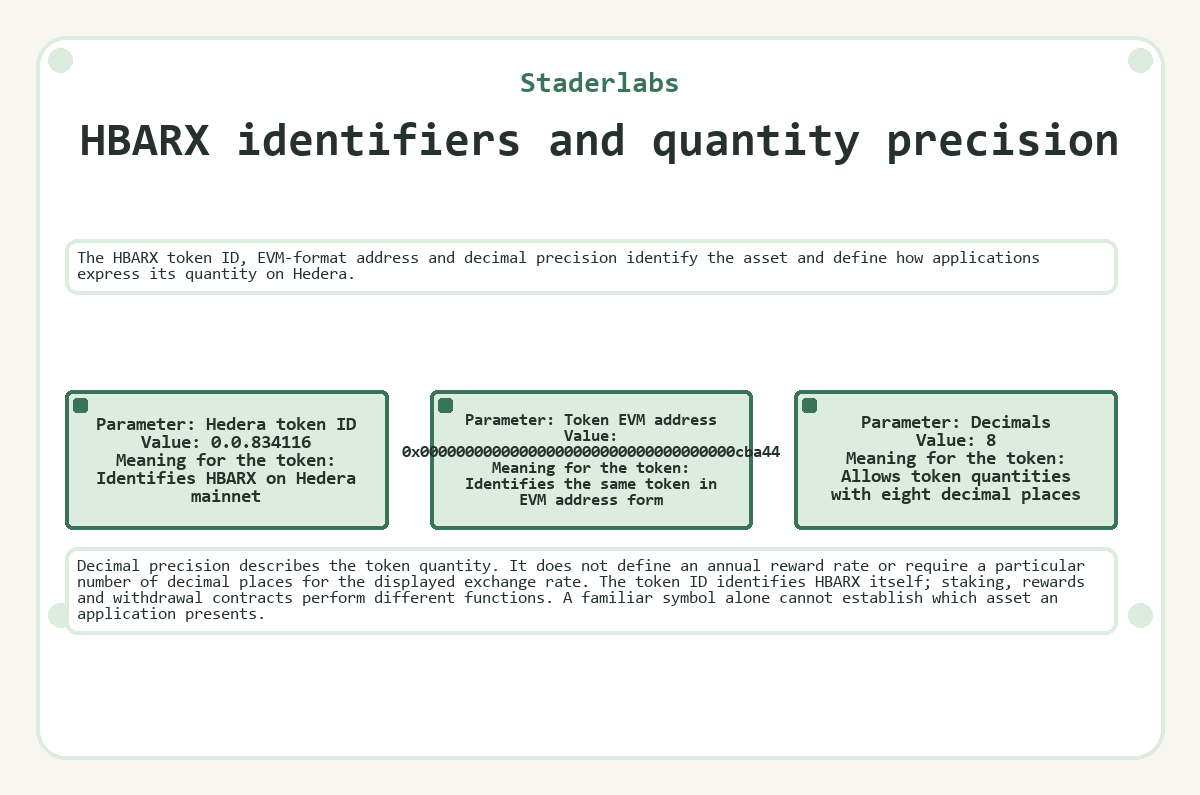
The HBARX token ID, EVM-format address and decimal precision identify the asset and define how applications express its quantity on Hedera.
| Parameter | Value | Meaning for the token |
|---|---|---|
| Hedera token ID |
0.0.834116
|
Identifies HBARX on Hedera mainnet |
| Token EVM address |
0x00000000000000000000000000000000000cba44
|
Identifies the same token in EVM address form |
| Decimals | 8 | Allows token quantities with eight decimal places |
Decimal precision describes the token quantity. It does not define an annual reward rate or require a particular number of decimal places for the displayed exchange rate. The token ID identifies HBARX itself; staking, rewards and withdrawal contracts perform different functions. A familiar symbol alone cannot establish which asset an application presents.
Does HBARX keep earning rewards during unstaking?
HBARX submitted for unstaking stops accruing staking rewards when the unstaking process begins. This cutoff applies to the tokens included in that request. An unstaking position therefore does not receive later pool rewards simply because the HBAR withdrawal remains pending. Any HBARX still held outside the request retains its own exposure to the staking pool.
A release time determines withdrawal availability
HBARX unstaking on Hedera generally involves an approximately 24-hour waiting period before the associated HBAR becomes eligible for withdrawal. A pending request displays a release date and time, while an available request has an enabled Withdraw button. These states describe the request’s availability. They do not establish that a completed claim has already credited HBAR to the wallet.
Unstaking and withdrawing have different effects: the former initiates conversion out of HBARX, while the latter claims the HBAR once available. An approval concerns the contract’s token-handling permission. The approximate waiting period describes HBARX redemption through Stader, not the execution time of a market swap.
Contract calculations and DeFi positions carry different risks
HBARX depends on contracts managing pooled HBAR and calculating token conversions, so accounting errors can affect the assets available to holders.
An incorrect exchange rate can distort how much HBARX a deposit mints or how much HBAR a redemption removes. That creates a risk to other pool participants as well as the affected transaction. Contract audits address implementation weaknesses, while Hedera network operation and wallet security remain separate dependencies. A correct token identifier establishes the asset’s identity; it does not establish the security of an application requesting permission to use it.
Holding HBARX inside a lending or liquidity application adds that application’s contracts and position rules. A change in the external position can have a different cause from a change in HBAR per HBARX. Distinguishing those layers helps separate staking accrual from application rewards, trading effects and access to the underlying assets.
Holding HBAR and holding HBARX provide different exposure
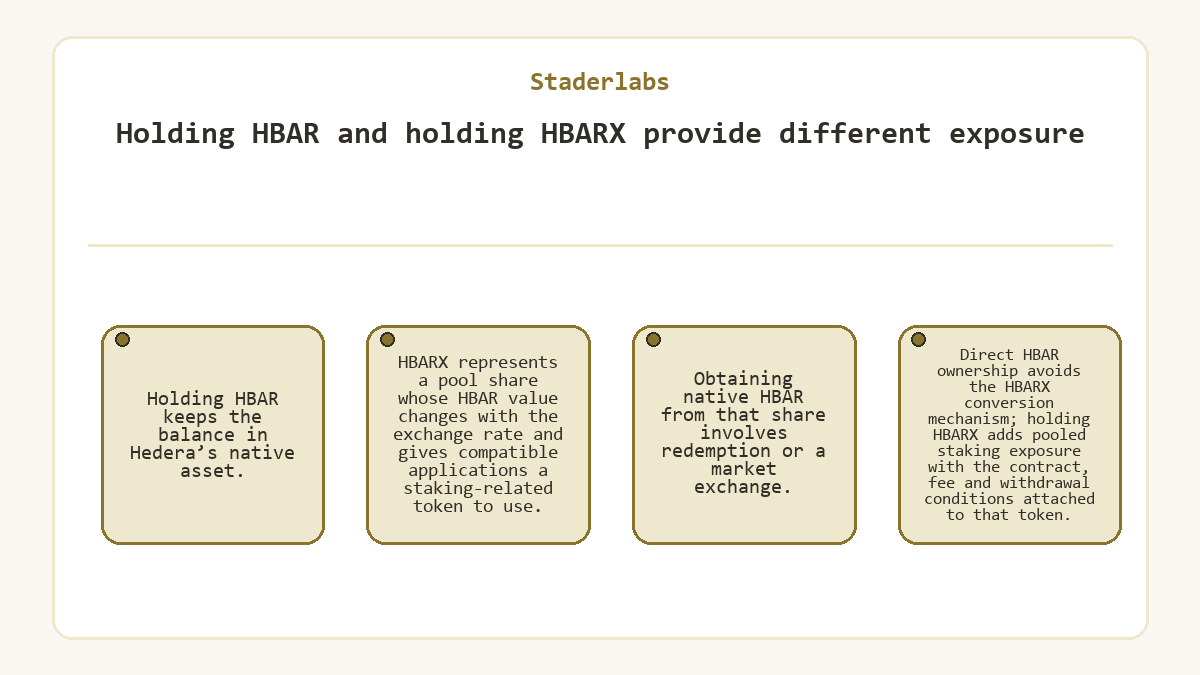
Holding HBAR keeps the balance in Hedera’s native asset. HBARX represents a pool share whose HBAR value changes with the exchange rate and gives compatible applications a staking-related token to use. Obtaining native HBAR from that share involves redemption or a market exchange. Direct HBAR ownership avoids the HBARX conversion mechanism; holding HBARX adds pooled staking exposure with the contract, fee and withdrawal conditions attached to that token.
Staderlabs: reader questions
Was the HBARX exchange rate fixed at launch?
HBARX launched with an initial exchange rate of one HBAR per HBARX. That starting value did not establish a permanent one-to-one conversion. Subsequent reward additions change the HBAR represented by each token, so the launch rate does not determine a later deposit’s token output.
Do I need to claim HBARX staking rewards separately?
HBARX staking rewards accrue through the pool exchange rate, and Stader’s contracts restake accumulated HBAR rewards for auto-compounding. Holding HBARX does not require a separate claim of newly issued HBARX for each reward addition. Claiming HBAR after unstaking is a different operation from reward accrual.
Can a market purchase of HBARX create new tokens?
A market purchase transfers existing HBARX rather than minting tokens through the staking contract. New HBARX originates when someone stakes HBAR with Stader. The price a buyer pays comes from the market transaction, so purchasing the token does not necessarily reproduce the staking contract’s conversion quote.
Why can an HBARX withdrawal amount differ from the unstaking estimate?
The exchange rate can change between an unstaking estimate and the request’s processing. An initial displayed HBAR amount therefore need not equal the final withdrawal amount. The pending request’s amount and the available withdrawal concern different processing states; an earlier estimate does not establish how much HBAR has reached the wallet.
Does an annual HBARX reward rate predict the full year’s return?
An annualized HBARX reward rate describes a changing pace of staking accrual, not a fixed payment for the coming year. Actual reward additions depend on the Hedera staking rewards reaching the pool and the applicable commission. A displayed percentage cannot establish the exchange rate at a future withdrawal.
Why can a staking deposit produce fewer HBARX than the HBAR deposited?
A deposit produces fewer HBARX than its HBAR amount when the applicable rate exceeds one HBAR per HBARX. The contract divides deposited HBAR by that rate to calculate the token output. Each token then represents more than one HBAR, so a smaller token count alone does not indicate a deposit fee.