 Staderlabs
 node operators run Ethereum validators through ETHx pools
Updated onStaderlabs node operators run Ethereum validators for ETHx and earn rewards for maintaining staking infrastructure. Permissionless entry uses an ETH bond plus SD collateral per validator; permissioned entry requires operating experience, identity checks and Stader DAO approval. Stakers supply pooled ETH through the ETHx staking protocol, while operators perform validator duties and receive their applicable reward share. The model separates the capital supporting a validator from the software running it, with additional obligations when the SD Utility Pool supplies collateral.
On this page
Bonded entry and approved entry lead to different pools
Permissionless entry depends on collateral, while permissioned entry depends on operating credentials and approval.
Permissionless collateral requirements
The documented permissionless model requires a 4 ETH bond and SD collateral worth at least 0.4 ETH per validator. The SD requirement measures value in ETH, so it does not mean depositing 0.4 SD tokens. Operators also need the infrastructure and software to perform Ethereum validator duties. Supplying collateral alone does not provide a running validator.
Permissioned approval requirements
Permissioned applicants need prior Ethereum node experience, know-your-customer or know-your-business checks and Stader DAO approval. This model admits selected operators without the permissionless security bond. Approval governs entry to that pool; the operator must still run the required validator infrastructure.
Operator bonds and pooled ETH fund separate shares
In the documented 32 ETH permissionless model, each validator combines a 4 ETH operator bond with 28 ETH from the staking pool. Although the operator runs the validator supporting both contributions, ETHx stakers retain their economic share through the protocol, so the validator’s total balance does not represent capital the operator can withdraw for its own account.
SD serves a separate collateral function. It is the Stader utility and governance token, rather than the liquid staking receipt issued against pooled ETH. An ETHx token balance represents staking exposure; an operator’s SD bond supports participation in the permissionless validator system. Neither asset substitutes for the ETH bond.
Client synchronization comes before validator registration
A configured, synchronized Ethereum node is a prerequisite for registration and validator addition through the Stader node software. The operator supplies and maintains its hosting environment.
Execution and consensus clients
The setup includes execution and consensus clients, along with the Stader command-line interface and its configuration manager. Client selection, network configuration and synchronization precede validator registration. Connectivity, storage and software maintenance remain operating requirements after setup.
Node registration and validator addition
Registration establishes the operator’s node within the ETHx system. Adding validators supplies the validator-specific information and funding the protocol needs. These are distinct stages, although the software coordinates their interaction. The permissionless setup also offers self-funded SD collateral and SD Utility Pool utilization where the available collateral does not cover validator addition.
Fee recipients and withdrawal vaults
Permissioned operators generate their validator keys and load them into Web3Signer. They use a separate validator client for Stader and direct its execution fees to the required Socializing Pool. The validator keys support signing, while fee-recipient contracts collect execution rewards and withdrawal vaults handle exited validator funds.
How do ETHx operators receive their rewards?
Consensus-layer ETH rewards reach each validator’s withdrawal vault, where the protocol splits them among stakers, the operator and the protocol treasury. Operators then claim their available share from the claim vault to their configured reward address. Consensus duties include attestations and block proposals. Execution rewards include priority fees and maximal extractable value, or MEV, associated with proposed blocks.
The documented fee schedule deducts 10% from rewards attributable to stakers’ ETH, allocating 5% each to the protocol and node operators. In the 4 ETH permissionless model, this commission applies to rewards on stakers’ 28 ETH; operators also receive rewards on their own bond. Permissioned validators apply the commission split to rewards on all 32 ETH from stakers. These percentages describe the reward allocation, not an annual return on the operator’s deposited ETH. Infrastructure expenses and any SD utilization charges affect the operator’s net outcome.
For permissionless operators, the Socializing Pool collects execution rewards from participating nodes and distributes shares across participants and ETHx stakers. Distribution considers validator performance and participation during the reward interval. Pooling changes how operators share block-proposal rewards; it does not assign every validator the same reward amount.
Permissionless operators who opt out use a node-specific fee-recipient contract for execution rewards. The contract divides those rewards between the operator and ETHx stakers. Funds move into the claim vault before the operator claims the applicable share to the operator reward address. An execution-fee recipient and an operator reward address have different roles.
Each reward cycle’s Merkle tree allocates SD rewards and, for Socializing Pool participants, pooled ETH rewards. Operators select unclaimed cycles and claim to the configured operator reward address. Opted-in operators claim pooled ETH and SD together; opted-out operators claim SD separately from their execution rewards. A displayed allocation, funds held by a collection contract and a completed claim represent different points in the payment path.
SD funding choices introduce different ongoing obligations
The source of SD collateral changes the operator’s funding exposure and repayment obligations without changing the need for sufficient validator backing.
Self-funded SD
Self-bonding commits the operator’s own SD to the collateral contract. Because the requirement measures SD in ETH terms, relative price changes can alter the collateral value without changing its token quantity, while daily snapshots determine whether the position meets the value required for SD reward eligibility. A position below the required value at the snapshot misses that day’s SD collateral rewards. The documented reward cap is 8 ETH worth of SD per validator; additional collateral earns no SD rewards.
SD Utility Pool utilization
The Utility Pool lets operators source delegated SD for collateral and pay a utilization fee. A node needs at least one validator active or in the deposit process. The documented utilization limit is 1 ETH worth of SD per validator. Within that limit, the CLI range depends on validator count, the existing utilization position and available pool supply. The utilization position includes the SD used plus accrued fees. This option avoids acquiring that SD outright, while adding an obligation the operator must manage alongside its ETH bond.
Comparing SD top-ups when collateral needs prompt attention
How do self-bonding and pooled SD compare for a top-up before the daily reward snapshot? In this hypothetical case, an existing operator’s SD backing has fallen below the required value. The operator has enough usable SD for a top-up, and the CLI also offers a sufficient Utility Pool utilization range. The next random daily snapshot makes confirmation timing relevant.
Depositing the operator’s own SD requires sufficient token approval and a successful collateral deposit. The contract then records the additional bonded SD. Utilizing pooled SD draws on delegated supply within the offered range and adds the associated utilization obligation. Both choices require the collateral position to reflect the additional backing.
In this example, the operator self-bonds and the deposit succeeds. The contract records collateral at or above the required value without adding pool utilization. Eligibility for that day’s SD rewards still depends on the value at the daily snapshot; submitting a transaction before the snapshot does not establish its completion.
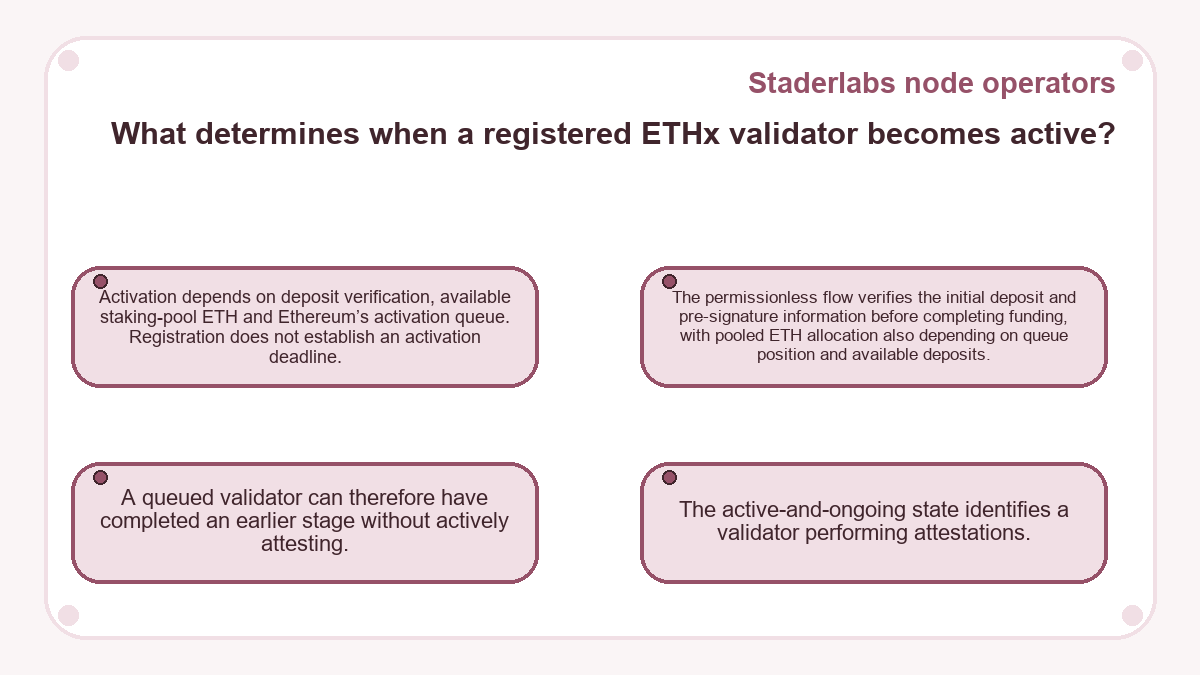
What determines when a registered ETHx validator becomes active?
Activation depends on deposit verification, available staking-pool ETH and Ethereum’s activation queue. Registration does not establish an activation deadline. The permissionless flow verifies the initial deposit and pre-signature information before completing funding, with pooled ETH allocation also depending on queue position and available deposits. A queued validator can therefore have completed an earlier stage without actively attesting. The active-and-ongoing state identifies a validator performing attestations.
Uptime, slashing and utilization expose different losses
Operating failures affect validator performance, while slashing and Utility Pool liquidation create distinct risks to bonded capital. Operators must maintain connectivity and synchronization throughout the validator’s life. They also need software updates, access controls and monitoring to detect failures. A funded validator cannot perform its duties through an unavailable or unsynchronized client.
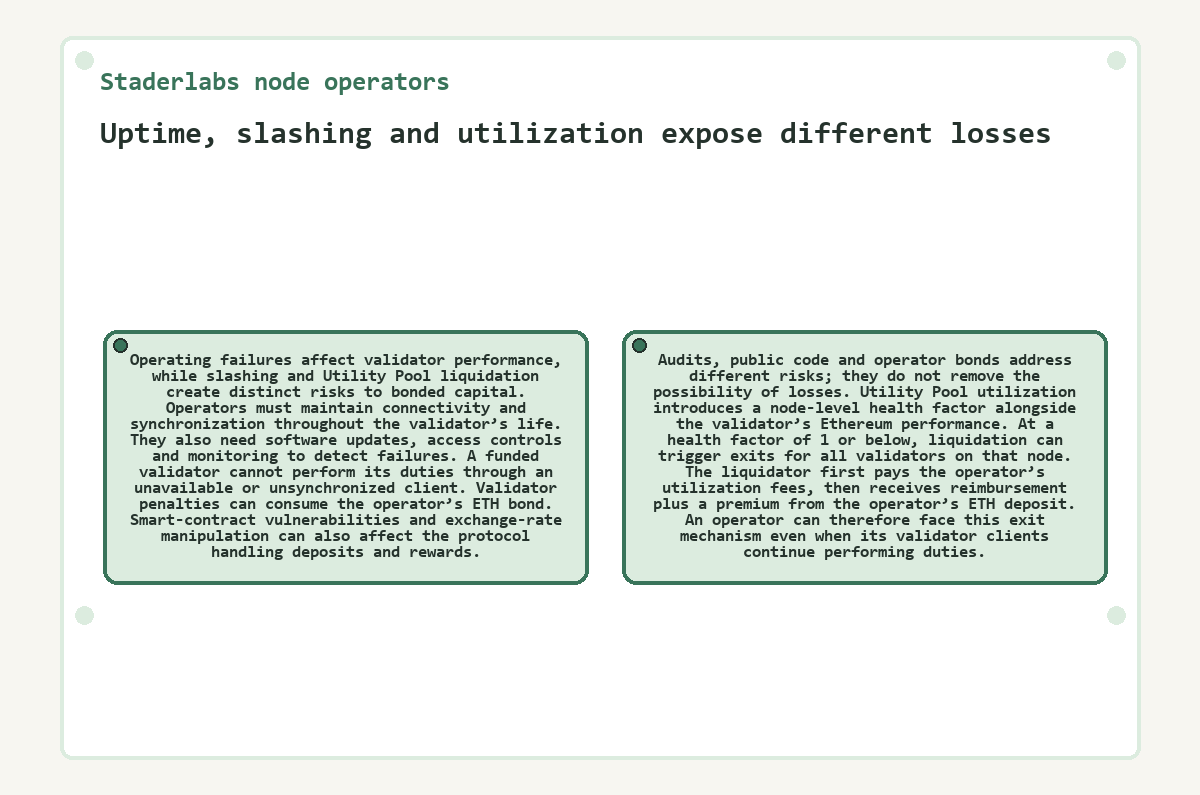
Validator penalties can consume the operator’s ETH bond. Smart-contract vulnerabilities and exchange-rate manipulation can also affect the protocol handling deposits and rewards. Audits, public code and operator bonds address different risks; they do not remove the possibility of losses.
Utility Pool utilization introduces a node-level health factor alongside the validator’s Ethereum performance. At a health factor of 1 or below, liquidation can trigger exits for all validators on that node. The liquidator first pays the operator’s utilization fees, then receives reimbursement plus a premium from the operator’s ETH deposit. An operator can therefore face this exit mechanism even when its validator clients continue performing duties.
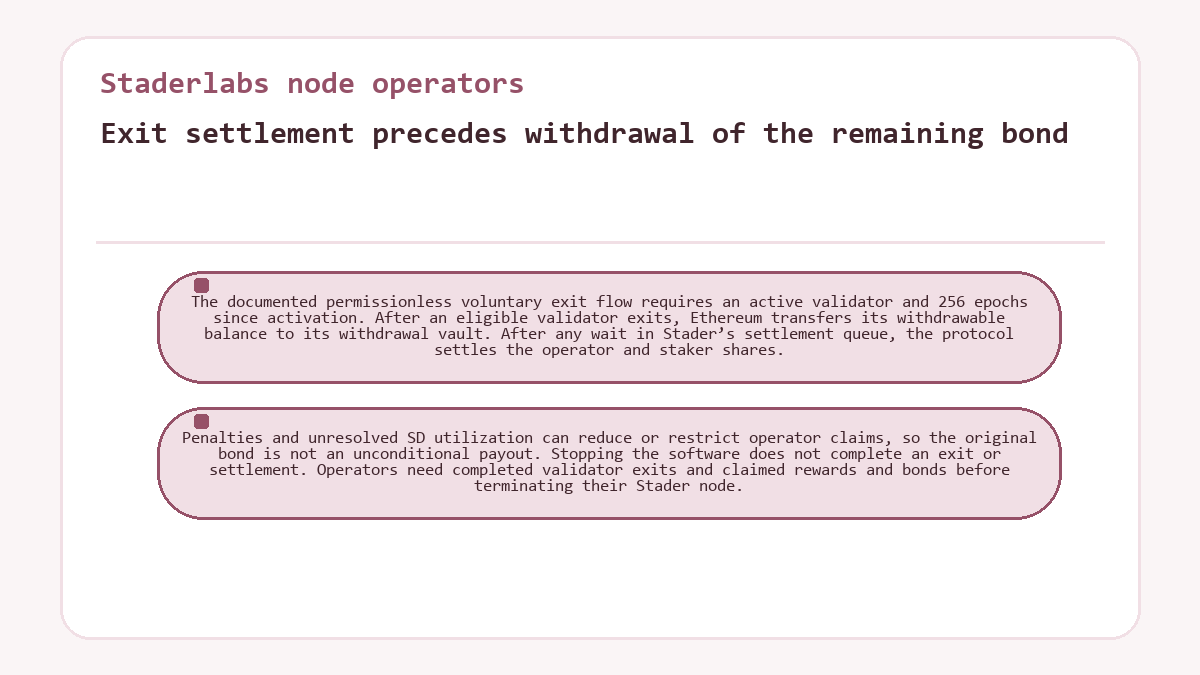
Exit settlement precedes withdrawal of the remaining bond
The documented permissionless voluntary exit flow requires an active validator and 256 epochs since activation. After an eligible validator exits, Ethereum transfers its withdrawable balance to its withdrawal vault. After any wait in Stader’s settlement queue, the protocol settles the operator and staker shares. Penalties and unresolved SD utilization can reduce or restrict operator claims, so the original bond is not an unconditional payout. Stopping the software does not complete an exit or settlement. Operators need completed validator exits and claimed rewards and bonds before terminating their Stader node.
Helpful answers about Staderlabs node operators
Does one Socializing Pool setting cover all validators on an ETHx node?
A permissionless operator’s Socializing Pool choice applies at node level and includes all validators on that node. Their performance and the time the node participates affect its share of the pool’s execution rewards. An operator therefore cannot treat this setting as an individual-validator option.
Can I withdraw self-funded SD while my ETHx validators remain active?
The documented collateral rules permit withdrawal of SD above the 200% collateral threshold, equivalent to 8 ETH worth of SD per validator in the 4 ETH bonding model. If the node also has a Utility Pool position, the contract applies withdrawn SD to repayment before sending any remainder to the operator reward address. Withdrawing the entire SD collateral requires exiting the validators. The withdrawal threshold and the minimum value needed for SD reward eligibility serve different purposes, so meeting the reward minimum does not make all remaining collateral freely withdrawable.
Do permissioned ETHx operators create their own withdrawal vaults?
Stader generates withdrawal vaults for permissioned validators, so those operators do not need to create the vaults themselves. Operators generate their validator keys and load them into Web3Signer for signing.
Are U.S. residents eligible to delegate SD to support ETHx operators?
The SD Utility Pool’s participation terms exclude U.S. citizens and residents. They also exclude individuals or entities operating within jurisdictions under U.S. government control or jurisdiction, including participation on behalf of affected residents or entities. The restriction applies to Utility Pool participation, including SD delegation supporting ETHx operators.
Can Stader testnet and mainnet nodes run simultaneously on one machine?
The Stader setup instructions prohibit running its testnet and mainnet nodes simultaneously on the same machine. Shared directories and ports can cause conflicts. Before reusing a testnet host for mainnet, terminate the testnet node and remove the testnet Stader directory.