 Staderlabs
 ETHx has different exit routes on Ethereum and Arbitrum One
Updated onStaderlabs ETHx holders can unstake on Ethereum, while holders on Arbitrum One can use a decentralized exchange to receive ETH. They can also bridge ETHx from Arbitrum One to Ethereum and use the protocol withdrawal route. Choosing between these exits means weighing the market quote against network charges, bridging costs and the withdrawal wait. ETHx represents staked ETH, so its pool exchange rate and its trading price can answer different questions.
Arbitrum One swaps and the Ethereum fallback
On Arbitrum One, a supported decentralized exchange provides a market exit; bridging ETHx to Ethereum provides a protocol-redemption alternative. A swap exchanges the token against available trading liquidity. Its quoted ETH output reflects the selected trade and the market available to execute it. That can differ from the ETH value implied by the staking pool. The bridge route changes where the ETHx sits before redemption. It does not itself convert the position into withdrawn ETH.
An unsuitable sale quote can make the bridge route worth comparing, especially when the desired destination is Ethereum. Bridge support, its charges and Ethereum transaction costs all enter that comparison.
The network and allowance determine unstaking readiness
An Ethereum ETHx balance and sufficient token allowance are prerequisites for requesting protocol redemption through the Ethereum interface. ETHx on Arbitrum One needs the supported cross-network transfer before that Ethereum balance exists. The network shown in the connected wallet therefore changes which token balance the interface can use.
Authorization for the selected ETHx amount
Token allowance gives the unstaking contract permission to handle ETHx up to an approved limit.
An allowance already covers the request
An existing allowance can cover the requested amount. In that case, the interface can proceed without a new approval.
The selected amount exceeds the allowance
If the selected ETHx amount exceeds the available allowance, approval must cover the intended request before unstaking proceeds. Review the token limit in the wallet prompt before confirming the permission.
A successful unstake request has its own record
A successful unstake request deducts the requested ETHx amount from the wallet balance and starts withdrawal processing. The Withdraw tab lists active requests. A signed approval alone does not establish that an unstake request succeeded.
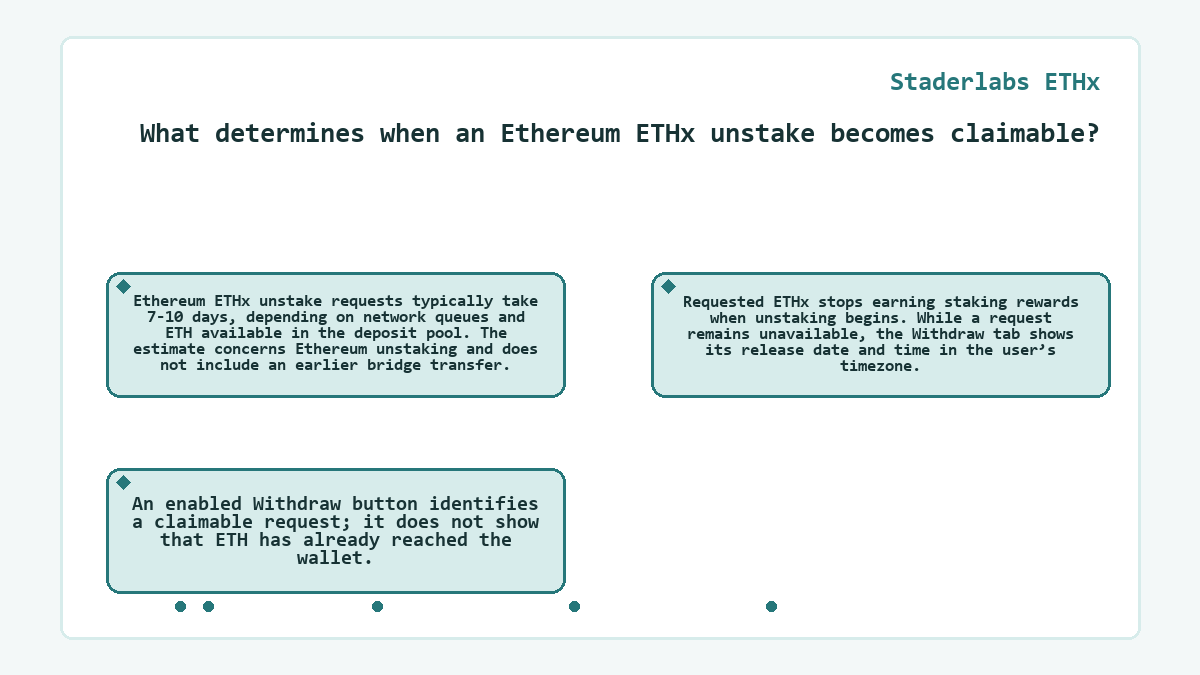
What determines when an Ethereum ETHx unstake becomes claimable?
Ethereum ETHx unstake requests typically take 7-10 days, depending on network queues and ETH available in the deposit pool. The estimate concerns Ethereum unstaking and does not include an earlier bridge transfer. Requested ETHx stops earning staking rewards when unstaking begins. While a request remains unavailable, the Withdraw tab shows its release date and time in the user’s timezone. An enabled Withdraw button identifies a claimable request; it does not show that ETH has already reached the wallet.
Pool value, reward fees and an executable ETH quote
The pool exchange rate expresses ETH backing each circulating ETHx token, while a swap quote expresses the output of a market trade. Calculate the pool rate by dividing total ETH in the staking pool by circulating ETHx. Its unit is ETH per ETHx. Multiplying a token balance by that rate gives its pool-based ETH value before applying the withdrawal conditions.
Staking rewards added to the pool can raise this exchange rate without increasing a holder’s ETHx quantity. A market sale uses the exchange’s executable quote for the selected amount. A pool valuation therefore does not establish the amount a sale will deliver.
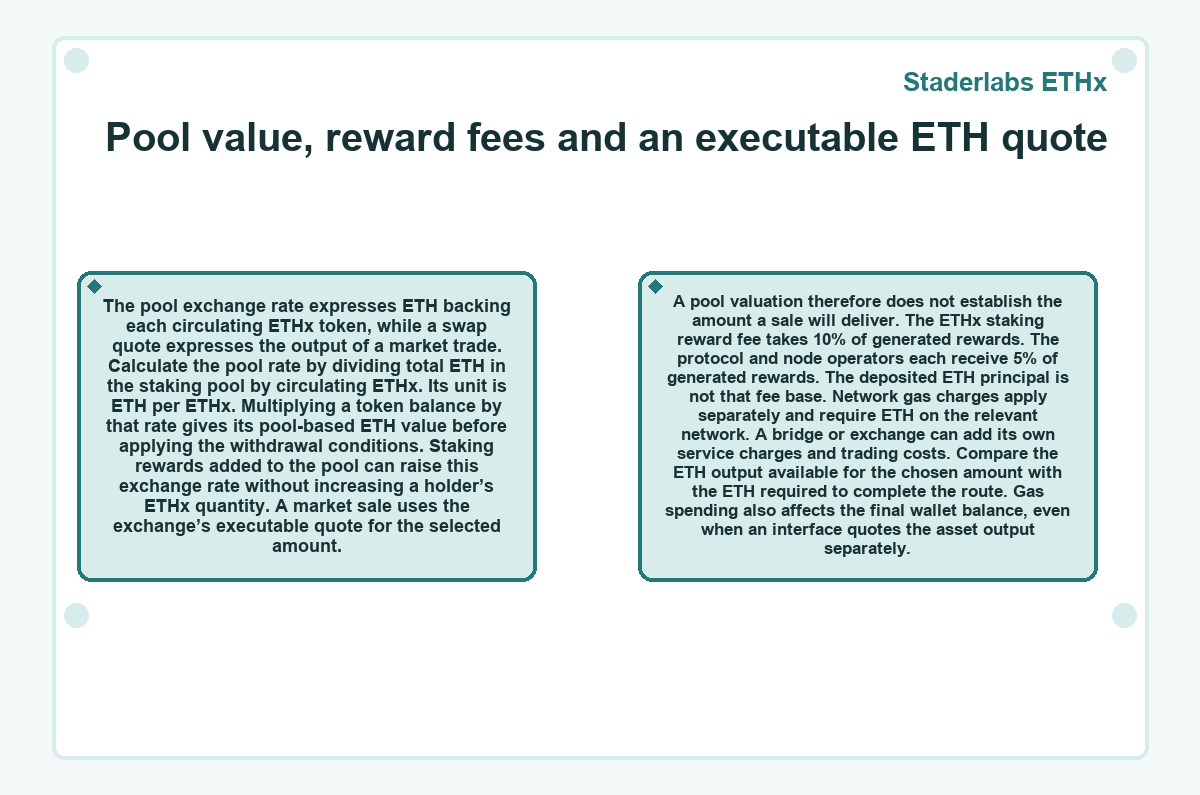
The ETHx staking reward fee takes 10% of generated rewards. The protocol and node operators each receive 5% of generated rewards. The deposited ETH principal is not that fee base.
Network gas charges apply separately and require ETH on the relevant network. A bridge or exchange can add its own service charges and trading costs. Compare the ETH output available for the chosen amount with the ETH required to complete the route. Gas spending also affects the final wallet balance, even when an interface quotes the asset output separately.
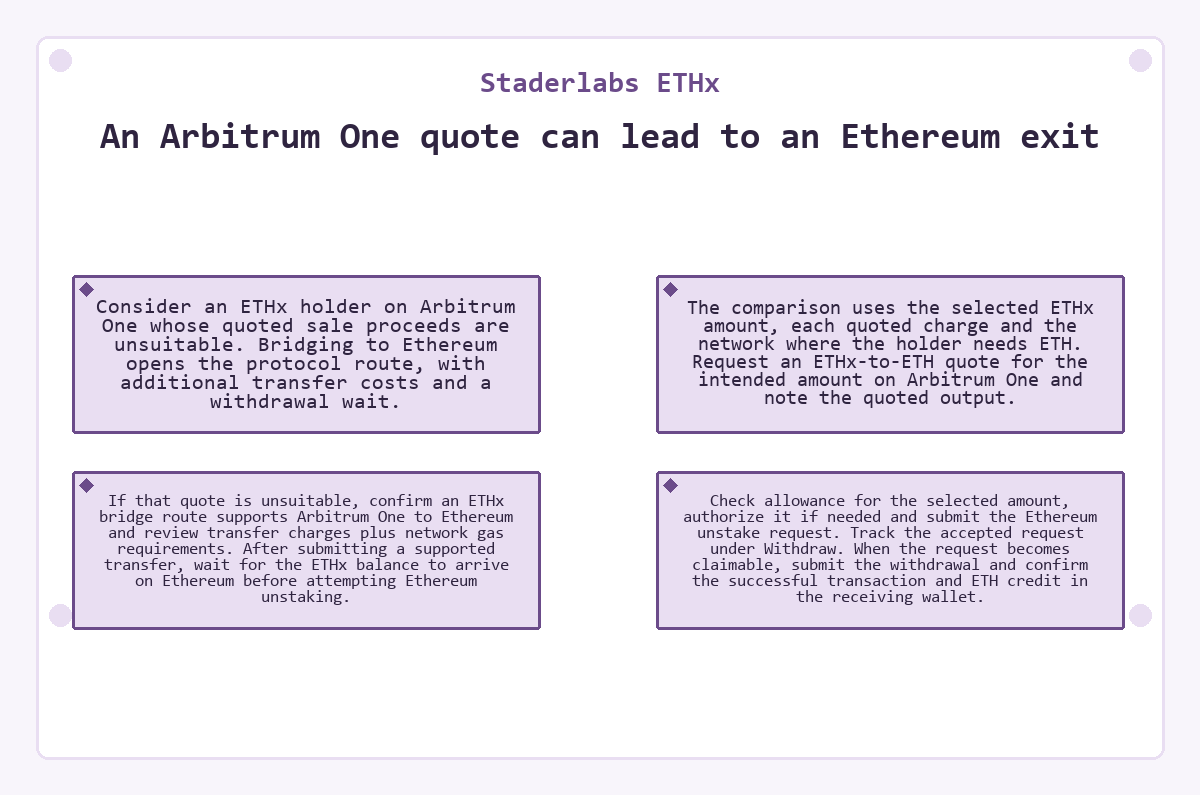
An Arbitrum One quote can lead to an Ethereum exit
Consider an ETHx holder on Arbitrum One whose quoted sale proceeds are unsuitable. Bridging to Ethereum opens the protocol route, with additional transfer costs and a withdrawal wait. The comparison uses the selected ETHx amount, each quoted charge and the network where the holder needs ETH.
- Request an ETHx-to-ETH quote for the intended amount on Arbitrum One and note the quoted output.
- If that quote is unsuitable, confirm an ETHx bridge route supports Arbitrum One to Ethereum and review transfer charges plus network gas requirements.
- After submitting a supported transfer, wait for the ETHx balance to arrive on Ethereum before attempting Ethereum unstaking.
- Check allowance for the selected amount, authorize it if needed and submit the Ethereum unstake request. Track the accepted request under Withdraw.
- When the request becomes claimable, submit the withdrawal and confirm the successful transaction and ETH credit in the receiving wallet.
Keeping ETHx preserves staking exposure alongside protocol risk
Keeping ETHx retains exposure to pooled staking rewards, while redemption converts the requested amount into ETH after processing. Smart-contract vulnerabilities, exchange-rate manipulation and Ethereum validator penalties can affect that staking position. Audits, open-source contracts and bug bounties address parts of this risk; they do not eliminate the possible loss. Using ETHx within another DeFi application also introduces that application’s own contract conditions. Its access and withdrawal conditions need not match Stader’s ETHx unstaking route.
The receiving network also changes the usefulness of an exit. An Arbitrum One swap returns ETH there, while an Ethereum withdrawal returns ETH on Ethereum. The same ticker does not make those balances interchangeable for a transaction on a particular network.
Still wondering about Staderlabs ETHx?
Why can the final ETH withdrawal amount differ from the initial estimate?
Stader’s Unstake documentation specifies the lower of the request-time and finalization-time exchange rates for the requested ETHx. Its published mainnet_V0 withdrawal contract applies the same cap. A rate decline before finalization can reduce the request-time estimate; a rise does not increase it.
Does the displayed ETHx annual staking rate already include commission?
The displayed annual ETHx staking rate accounts for the combined node operator and Stader commission. It annualizes rewards reflected in exchange-rate movements, so it does not lock in a year of rewards or determine a particular exit quote. Applying the same commission again to that displayed rate would double-count the deduction.
Will switching my wallet to Ethereum transfer my Arbitrum One ETHx?
Switching the wallet’s selected network does not transfer ETHx between Arbitrum One and Ethereum. It changes the network the wallet accesses. The Ethereum withdrawal route requires ETHx on Ethereum, which is why a cross-network transfer is a separate operation from changing the wallet display.
Must I claim ETHx staking rewards before selling the token?
ETHx reflects native staking rewards through its pool exchange rate, so holders do not need a separate reward claim before selling. The exchange’s quote determines what the sale pays in ETH.
Can I unstake only part of my ETHx balance?
You can request unstaking for a selected ETHx amount instead of your entire wallet balance. That request concerns the submitted tokens, which stop earning staking rewards when unstaking starts. ETHx outside the request does not enter that withdrawal merely because it sits in the same wallet.
Does holding ETHx create a Stader custody fee before I exit?
Stader does not charge deposit or custody fees for ETH staking through its dApp. That does not remove the reward fee or network transaction charges. An exchange or bridge can also charge for its own service, so custody fees alone do not measure the cost of an ETHx exit.